Pliers
Almost every software engineer I know harbours some fantasy about blue-collar work.
The frontend developer wondering about landscaping. The DevOps guy who keeps asking if it’s too late to retrain as an electrician. You see it constantly on Hacker News - threads full of people romanticising trades, physical labour, work you can point to.
There are obvious reasons for this. Our work is ephemeral. You rarely get to drive down the high street and tell your kids “I built that.” Most of what we create is buried behind layers of abstraction, invisible from the outside. We go entire careers without that experience.
And at some innate level, we’re wired to take pride in the physical outcomes of our work. Software marks a kind of departure from the world our regulatory systems evolved for. It would make total sense that we feel disconnected.
The grass is always greener
Worth noting: if you look at those Hacker News threads, people with relatives in the trades are quick to point out that the romanticisation cuts both ways. Tradespeople often envy the white-collar life - because working with your body as the vehicle for generating revenue tends to produce physical problems over the decades. Thousands of hours kneeling on hard floors. Inhaling dust. Repetitive strain in inconvenient places.
Nothing is free. Trade-offs are everywhere.
The toolbox
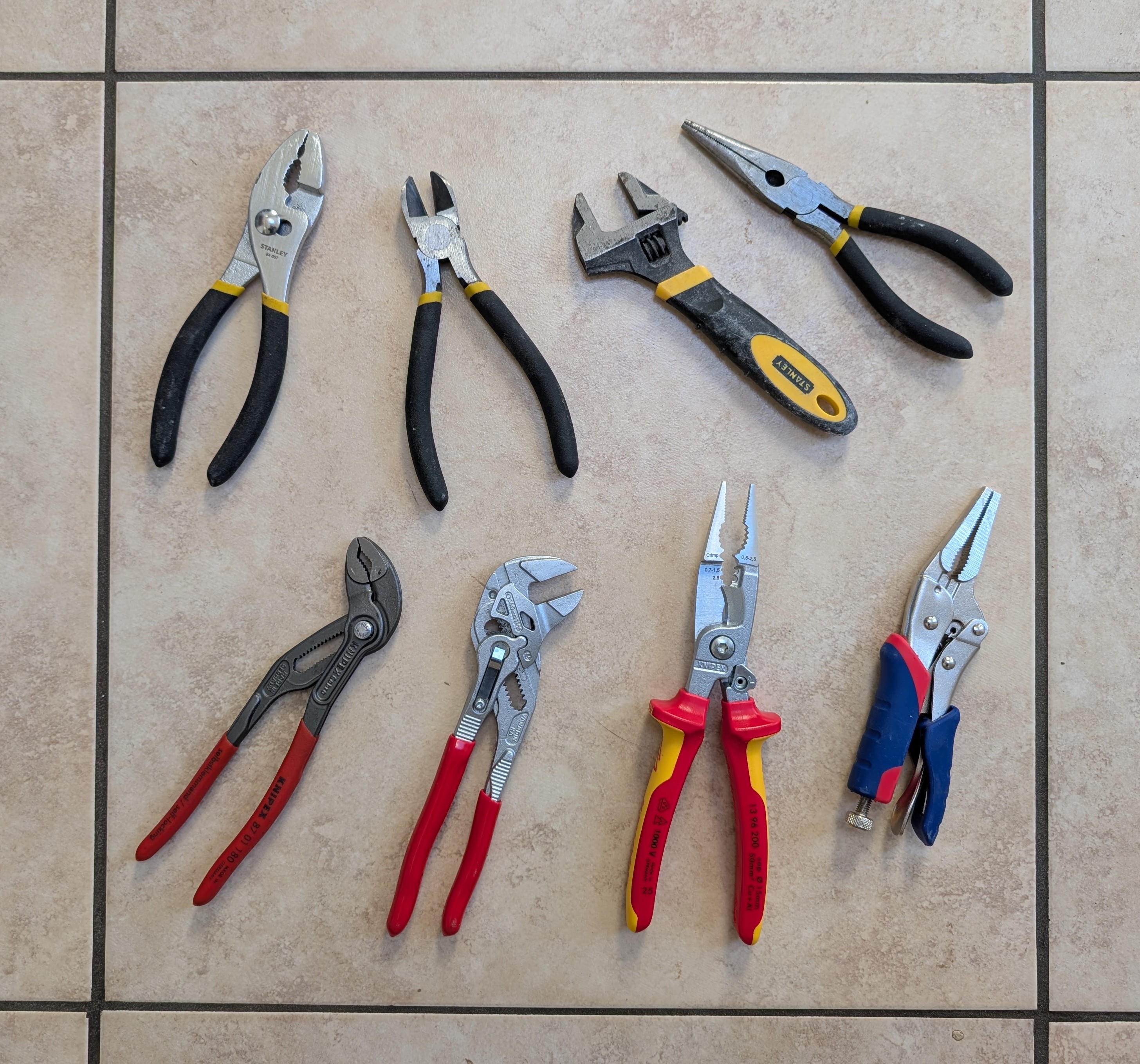
I mention all this because I’m no exception. As we’ve settled down as a family, I’ve found myself increasingly drawn to DIY. And along the way, I’ve built up a collection of pliers.
It’s not huge. But almost every pair has a story - how I found it, what job it got pulled out for.
Pliers are interesting. They’re an augmented hand - a grip better suited to the kinds of work we weren’t quite built for. They let you squeeze harder, hold hotter things, reach into tighter spaces. Each type is specialised for something a bare hand can’t quite do.
I’m genuinely attached to them. Which is a bit absurd, given my skill level. I’m not a tradesperson. I don’t need fifteen pairs of pliers. They bring me joy anyway.
The parallel
And this is where it connects back to software.
I’ve spent years building up a mental toolkit of coding paradigms, patterns, frameworks. Each one has a story. Each one gets pulled out for specific jobs. I’m attached to them in the same irrational way I’m attached to my pliers.
The problem is: the tools I picked up in the last year are already arguably obsolete. The paradigms I learned over my career are being abstracted away. The hand I augmented so carefully is becoming less relevant.
The migrations
This isn’t new, of course. Software has always involved periodic migrations - reluctant, gradual shifts from one set of tools and practices to another.
Assembly to higher-level languages. Waterfall to Agile. Monoliths to microservices. jQuery to React. Manual deployments to CI/CD. Each transition had its holdouts, its advocates, its people who’d built their identity around the old way. Each time, the industry eventually moved on.
But the cadence is speeding up. The gap between React feeling revolutionary and React feeling like legacy is shorter than the gap between jQuery and React. The frameworks I learned three years ago already have that slightly dated quality - not obsolete exactly, but no longer the obvious choice.
And now we’re not just swapping one tool for another. We’re abstracting away the activity that made the tools meaningful. It’s not “learn this framework instead of that one.” It’s “maybe stop thinking in terms of frameworks at all.”
The question
Maybe I should be learning something else entirely. Maybe attachment to tools is a liability when the tools are changing this fast.
Or maybe there’s something valuable in the attachment itself - a grounding, a connection to craft, a reason to care about the details even when the details are shifting beneath you.
There’s a stranger possibility too. Every migration involves a decision point: when do I cut my losses on the old way and pay the tax of learning the new one? Sunk costs versus opportunity costs. That calculation has always been ours to make - and we’ve often made it badly, clinging too long or jumping too early.
If the tools are increasingly chosen by AI, maybe that decision gets delegated too. Not the attachment - that stays with us. But the moment of reckoning, the choice about when to let go. That might not be ours to agonise over for much longer.
I don’t know yet. But I’m keeping the pliers.