Knees Out
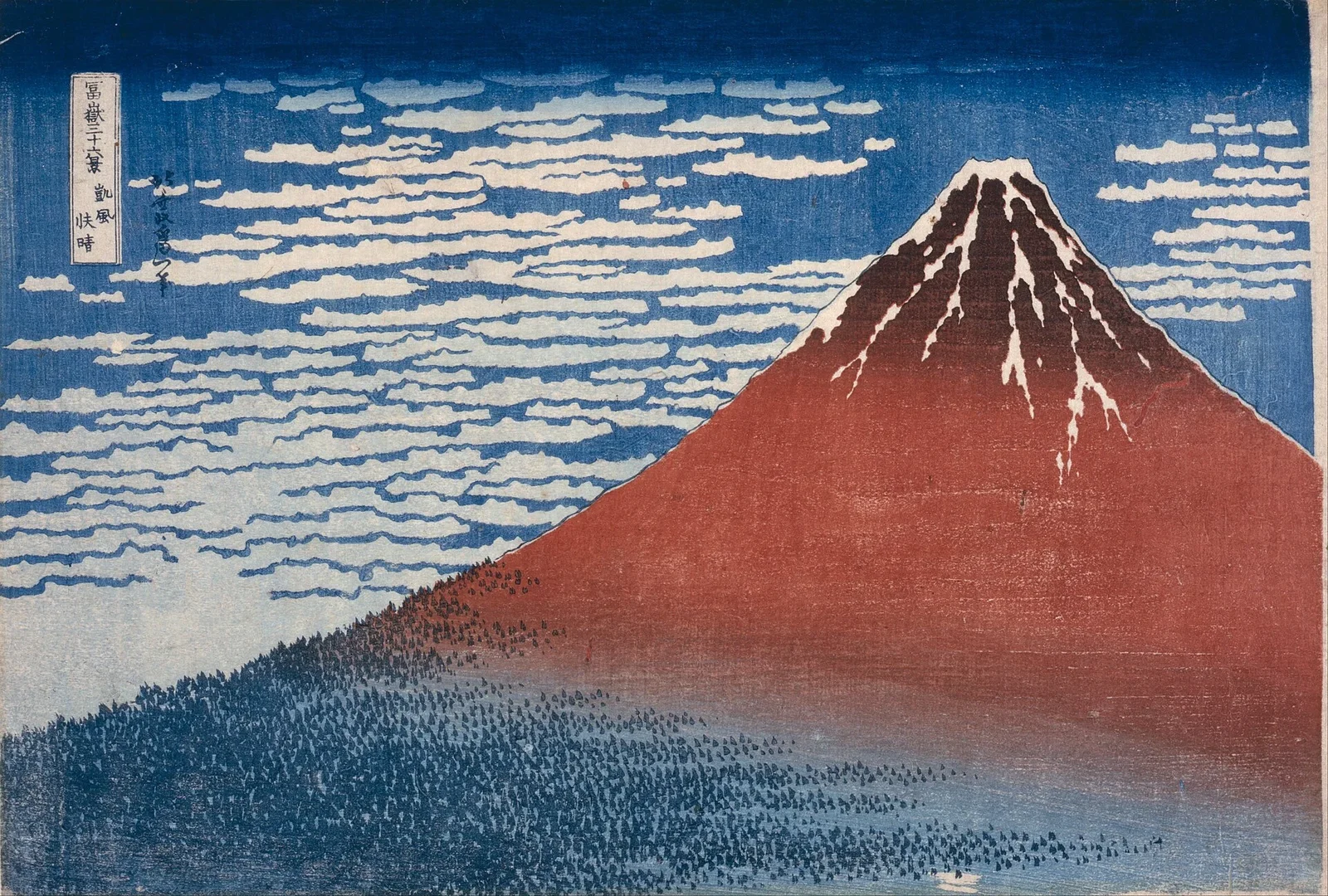 Katsushika Hokusai, Fine Wind, Clear Morning, from Thirty-six Views of Mount Fuji (c. 1831). Wikimedia Commons

Today I was dictating a fairly ridiculous prompt while walking the dogs. Find the transcript for this podcast, make a quote-heavy summary without analysis, post the video to the AI channel in Slack, then put the summary in a reply to that post. I’ve asked for versions of this enough times that I can already see most of the words disappearing.
The first time I do something with a model, the prompt is often a paragraph. After a few repetitions it gets shorter. Some detail turns out not to matter, some gets inferred reliably, and occasionally I shorten it too far and get something wrong. The correction goes back in. Eventually a paragraph becomes a phrase.
I used to be a runner, for a few years rather maniacally chasing a three-hour marathon. When I finally shook off the obsession I went almost entirely in the other direction and took up strength training. I was sufficiently cautious about the transition that I read Mark Rippetoe’s Starting Strength several times and followed the programme fairly literally.
One of the useful things I got from it had little to do with barbells. Starting Strength spends hundreds of pages explaining how the lifts work. Under a heavy bar, nobody wants the explanation. A coach has a second or two to make something change.
Knees out is a classic squat cue. The interesting thing about a cue is that it isn’t a compressed description of the error. It is an instruction chosen because it produces the correction. You can write pages about stance, femur angle and what happens when the knees cave in. Halfway through a hard squat, “knees out” is better.
The same goes for eye position. Rippetoe has written at length about why he wants the lifter looking at the floor. That explanation is useful when learning the movement. During the movement, you need something closer to “look down.” The explanation and the cue are different objects.
I think the same distinction is useful for prompts. I used to have fairly elaborate instructions for writing style. Through repeated use they have mostly collapsed into “plainer shorter.” It works better for me than the long version did.
This is not because “plainer shorter” is a particularly good prompt in isolation. Give it to somebody with no history and it is almost comically underspecified. It works because I got there by repeatedly asking for the same sort of thing, being dissatisfied in slightly different ways, shortening the instruction, putting bits back when the shortening broke something, and doing that enough times that I have a good sense of what the phrase evokes.
The failures are part of the compression. If I take out a word and the model starts doing something annoying, I learn that the word was carrying more weight than I thought. After enough repetitions the surviving phrase has quite a lot of experience packed into it.
I wrote in January about books as compressed prompts. A book title can be a pointer into a body of knowledge the model already has. This is a slightly different kind of compression. The pointer is being created through repeated interaction. The model and I arrive at a small local language for a task.
This is also roughly where my discomfort with skills starts. A skill gives a short name to a much longer file of instructions. Superficially that looks like the same thing: a few words standing in for a lot of detail. But the compression has usually happened the other way round. The detail was hidden first and the short name was stuck on afterwards.
Six months later, “writing style” might refer to a dozen rules I no longer remember. One may have been written to stop a particular bad habit in blog posts and turn out to be exactly wrong for an annual appraisal. Another file may add a local exception. Every addition is individually sensible and the combined behaviour gets harder to reason about anyway.
Software repositories are accumulating a lot of this sort of markdown. Instructions, exceptions to instructions, conventions, local conventions, notes about which conventions override other conventions. It always looks manageable at the point where one more rule is added. Over time people forget what the names mean, models ignore parts of the pile or reconcile them in surprising ways, and the whole thing acquires the usual problem of systems made from individually reasonable conditionals.
A cue has earned its compression. “Knees out” is short because somebody already did the long thinking, tried the short instruction on actual lifters and found that it reliably changed the movement. “Plainer shorter” means something to me because I was there while the longer version was being worn down.
Oddly, that can make the result easier to share rather than harder. A cue on its own may be opaque, but it remains close enough to the behaviour that another person can acquire it with a little explanation and feedback. Once they have felt what “knees out” corrects, the two words carry much more than they did before.
Long prompts are still useful. They may be how you discover the cue in the first place. Repeated work just seems to have a tendency to produce its own little vocabulary, with phrases worn down until they are barely long enough to invoke the right thing. The explanation teaches the movement. The cue is what you use under the bar.