Look Left
 Evelyn De Morgan, The Love Potion (1903), detail. Wikimedia Commons

A couple of weeks ago a new colleague asked me about something in Emacs, so I opened it to show them, and had to stop for a second to remember a really basic keyboard shortcut. I was an obsessive user of terminals and editors for a long time, and I hadn’t opened either in weeks. It was starting to fall away.
In January I wrote that the GUI was a detour. I had installed Audacity and barely opened it, because an LLM would write the ffmpeg command instead. At the time I took that as a story about applications. It turns out the terminal was a detour too, and so was the editor. They have gone the way of Audacity, for the same reason.
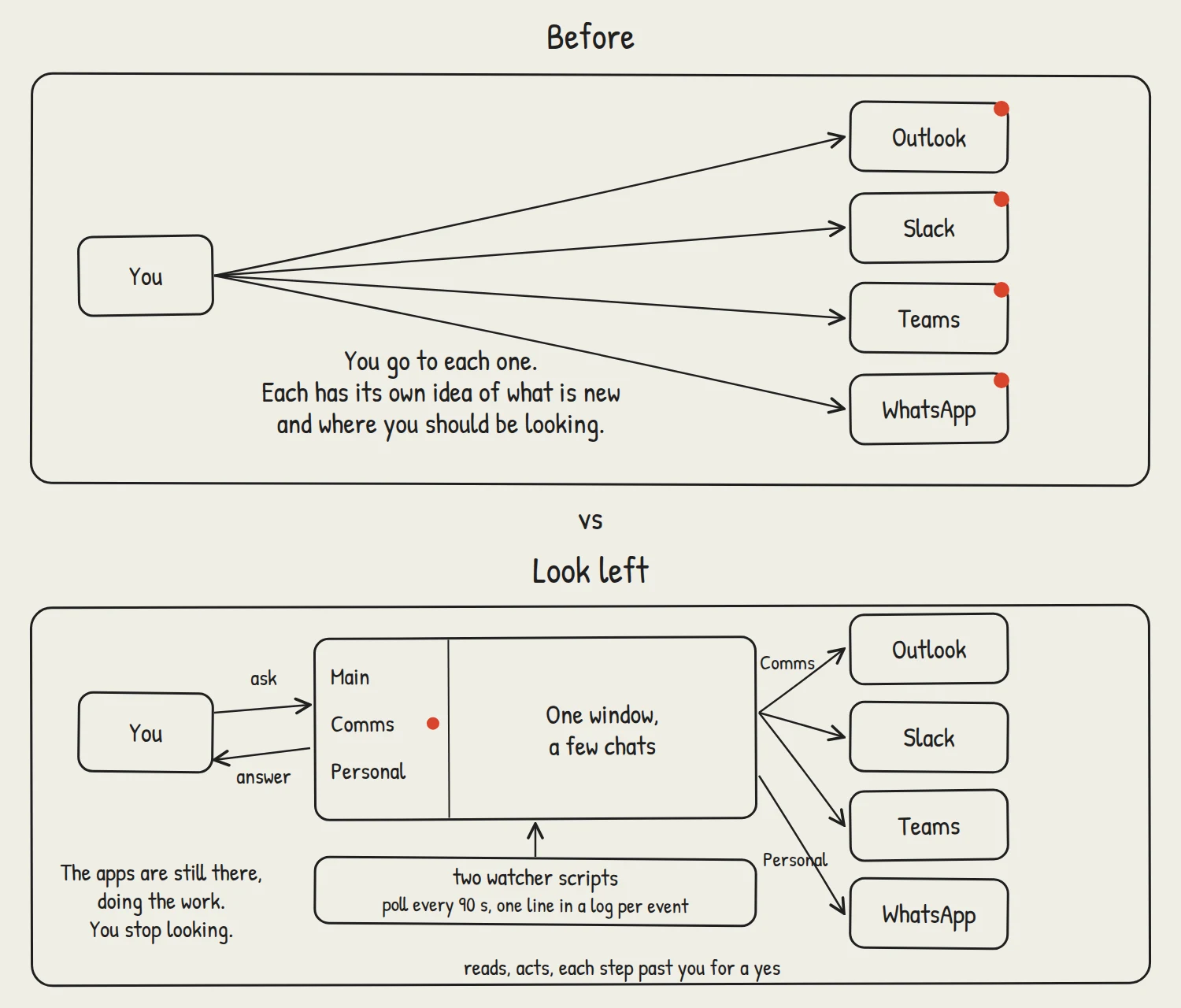
What replaced them is one window. Claude Desktop, mostly, with a handful of long-running chats in it. I give each one a broad purpose rather than a task. One has most of my work in it, along with the to-do list I’m actually worried about. I’m single-threaded, so that chat is where I am, and when something can be farmed out to run in parallel it gets farmed out from there. Another handles my communications. A few more run on a schedule and do one job each: a morning brief at six, a daily check on a server’s disk.
The communications one is the part I find most interesting. The chat itself does no polling. A small script does that: every ninety seconds it looks at Slack, my inbox, Teams and the calendar, and if a person has sent something new it writes a line to a log. The chat watches the log, which is why I think of it as a watcher, and sleeps until a line appears. Then it wakes, reads the event, deals with it, and a dot appears next to it in the sidebar. So if I want to check my email I look left, rather than switching to another window and reading down a list. Something has already read it, decided whether it matters, and either told me or stayed quiet.
There are two of these, one for work and one for personal, and each covers a lot of ground. My favourite thing the work one catches is a Slack channel where our servers post a health check every morning. The check posts under my name, because I set it up, so Slack never notifies me about it. It’s addressed to me and I’d never see it. Now it comes to me like everything else.
The window also reaches the rest of the computer, the servers at work, and the browser. It will quite happily prompt ChatGPT for me, which removed one of the last reasons I had for keeping another web app open. Each action still goes past me for a yes, so I’m hardly out of the loop, but I don’t leave the window to do any of it. Last week it read our internal notes to get a sense of what sort of company we are before choosing the office hot chocolate. Cadbury, as it turned out.
The web apps are still there. They’ve become a fallback, the place I go when the chat can’t do something, and that is a shorter list every month.
I’m aware this sounds like a lot of tooling. From the inside it feels like less. For years my attention was split across a browser tab per app, each with its own notion of what was new and its own idea of where I should be looking. Now attention sits in one place and things come to it. The question of which window to be in has mostly gone away.
For three years the assumption has been that AI would arrive as a feature inside the software we already use. A Copilot button in Excel, a summarise button in the inbox, an assistant tucked into the corner of every app. That is still what most software looks like. On my desk it has gone the other way round. The chat window is the application, and Excel, Outlook and Slack have become things it reaches into when it needs them. They still do the work. I just don’t look at them. Geoffrey Huntley wrote this morning about JetBrains Kodaking itself out of business by treating AI as something to add to the IDE while the IDE was the thing being displaced. Same move, one level up.
A friend sent me a diagram in which the agent replaces the whole SaaS layer and talks straight to the database. From my desk it looks more like this.
I’m deliberately careering towards this being my only interface. I resent unlocking my phone now. I don’t want to navigate to anything with my thumbs. I want to start a conversation and have it go wherever it needs to go. A colleague put it well this week: at some point there will be a thing with no start button and no grid of apps, you just talk. Until someone builds that, a chat app with a few watchers is a reasonable approximation, and I keep looking left.